

Technical · ANPR / LPR · 2026-10-04
What is an ANPR camera, and how does it read a number plate?
An ANPR camera photographs a plate and software turns it into text. What makes it work is not resolution: it is a reflective plate, a very short shutter and the right angle. Here are the numbers, from 3M and Axis.

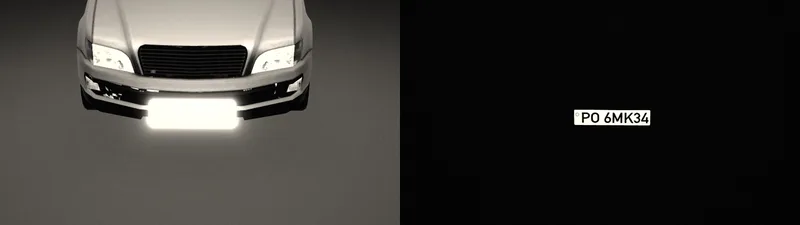
The short answer
- ANPR (automatic number plate recognition) is the British name; in the US the same thing is LPR, ALPR or a license plate reader. A camera takes the picture and software reads the characters.
- Number plates are retroreflective: they send light back to where it came from. In 3M's figures, a plate lit from beside the camera returns about 4,700 times more light than dark asphalt.
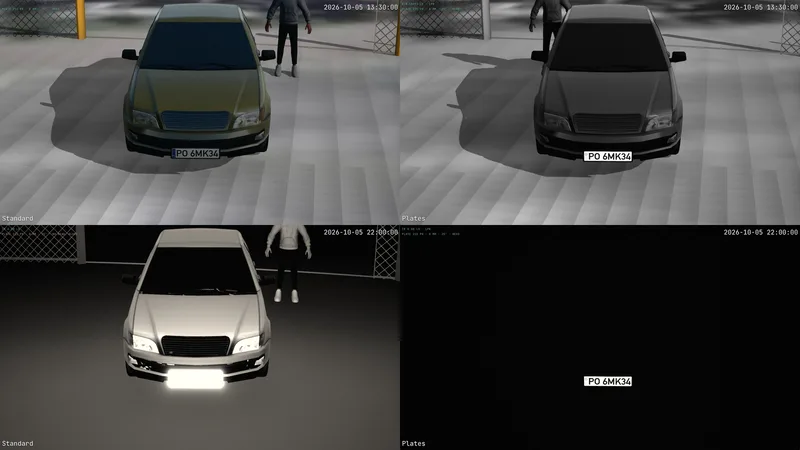
- So an ANPR camera exposes for the plate, not for the scene: a very short shutter and its own infrared, in a picture where the car is dark and the plate is bright.
- The shutter decides whether a moving plate can be read: the plate may smear no more than about 14 mm. At 50 km/h and 20° to the lane that means about 1/340 s or faster.
- The plate needs at least 75 pixels across it, and most reading software asks for 100 to 150. Keep the angle between camera and plate under 30°.
ANPR, LPR, ALPR, license plate reader: one thing
Automatic number plate recognition is the term in the UK, Europe and Australia. In the US the same system is called license plate recognition (LPR), automatic license plate recognition (ALPR) or a license plate reader. Each is a camera plus software: the camera delivers a sharp picture of the plate, and the software finds the plate in it and turns the characters into text that can be checked against a list.
That list is what gives the system its job: a car park opens the barrier for a registered car and times every stay, a company logs who came through the gate, and the police check plates against wanted vehicles. Average speed cameras use two ANPR cameras and the time a car takes between them; a single ANPR camera does not measure speed.
Why number plates are reflective
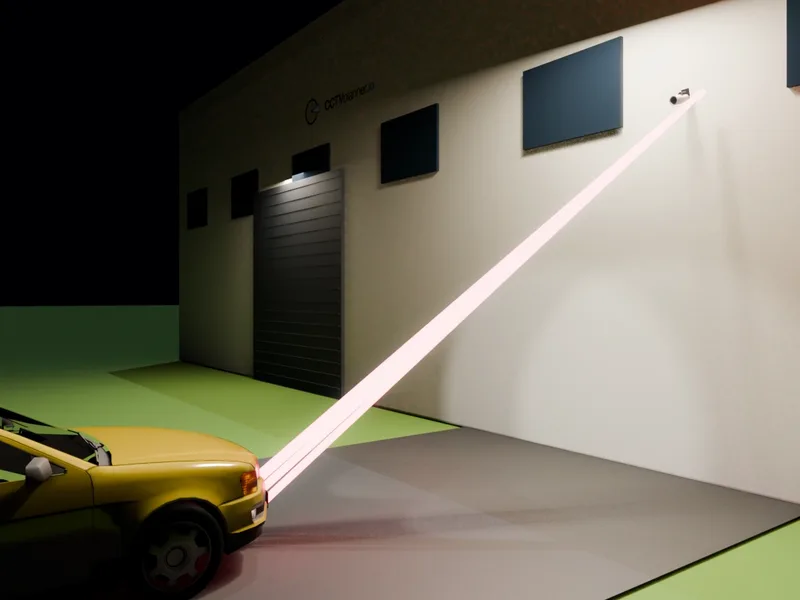
A number plate is covered in retroreflective sheeting: tiny prisms that send light back toward its source instead of scattering it. That is why a plate lights up in your headlights. 3M rates its white plate sheeting at 150 cd/lx/m² when the light comes from almost where the eye is. To look that bright, a matte surface would have to be 471 times brighter than perfect white paper. Dark asphalt is about a tenth of perfect white, so the plate returns roughly 4,700 times more light than the road.
A camera with infrared LEDs next to its lens is exactly that case. Its own light comes straight back from the plate and far less from everything else, so at night the plate is by far the brightest thing in the picture.
| Observation angle | Straight on (−4°) | At 30° |
|---|---|---|
| 0.2° | 150 | 26 |
| 0.5° | 45 | 13 |
| 1.0° | 20 | 7 |
3M PB Series 6750, Table 1, white sheeting, in cd/lx/m². The observation angle is the angle between the light and the lens as seen from the plate: it grows the further the infrared sits from the lens and the closer the plate is. Measured in visible light; no manufacturer publishes the figure at 850 nm, but the prisms reflect by total internal reflection, which barely depends on wavelength.
Why an ordinary camera struggles at night
At night an ordinary camera does the opposite of what a plate needs. To see a dark scene it keeps its shutter open as long as it can, often 1/30 s, and turns up the gain. A parked car is fine. A moving one is not: at 30 km/h a plate travels 28 cm in 1/30 s, and seen from 20° to the side that is a smear of 95 mm across the picture, almost seven times the 14 mm a plate can take.
Under its own infrared the plate can also overexpose in a picture set for the dark street around it, and the characters merge into a white patch.
What an ANPR camera does differently
An ANPR camera sets its exposure for the plate. It uses a very short shutter, low gain and its own infrared, often pulsed in time with the shutter, and often a filter that passes only the illuminator's wavelength. The plate, which returns its light so strongly, comes out clean; the car and the street around it go dark.
Many ANPR cameras therefore carry two channels: a monochrome one for the plate and a colour one for the car and its surroundings.
Shutter speed: the 14 mm rule
Axis's recommended shutter times for plate capture all follow one rule: the plate may move no more than about 14 mm across the picture while the shutter is open. What counts is the movement across the line of sight, so a camera looking down the lane at an approaching car can use a longer shutter than one looking from the side.
| Speed | 10° to the lane | 20° to the lane | 30° to the lane |
|---|---|---|---|
| 10 km/h (6 mph) | 1/34 s | 1/68 s | 1/99 s |
| 30 km/h (19 mph) | 1/103 s | 1/204 s | 1/298 s |
| 50 km/h (31 mph) | 1/172 s | 1/339 s | 1/496 s |
| 100 km/h (62 mph) | 1/345 s | 1/679 s | 1/992 s |
Longest shutter that keeps the smear under 14 mm (Axis, License plate capture white paper). The angle is between the camera's view and the direction the car travels.
How many pixels a plate needs
Axis puts the floor at 75 pixels across the plate: below that the characters lose contrast. Most plate-reading software asks for 100 to 150. A European plate is 520 mm wide and a US plate 12 inches (305 mm), so the same camera reads a European plate from further away.
| Field of view | European plate | US plate |
|---|---|---|
| 40° | 13.7 m (45 ft) | 8.0 m (26 ft) |
| 20° | 28.3 m (93 ft) | 16.6 m (54 ft) |
| 10° | 57.1 m (187 ft) | 33.4 m (110 ft) |
Furthest distance at which a 1920-pixel-wide (1080p) camera still puts 100 pixels across the plate, the low end of what reading software asks for. At night the camera's own infrared must reach that far too.
Mounting angle and height
Axis recommends keeping the total angle between camera and plate under 30°. Beyond that the characters foreshorten and the plate returns less of the camera's light: in 3M's table it falls from 150 straight on to 26 at 30°, about a sixth.
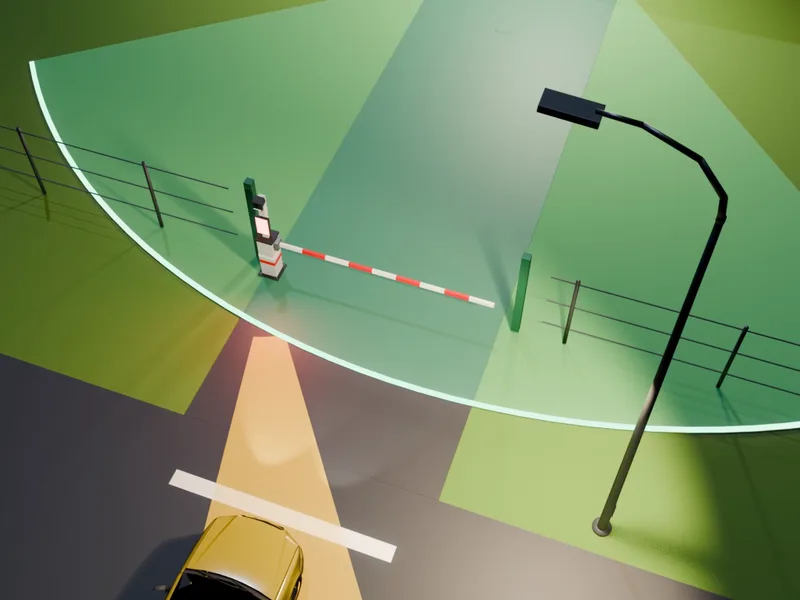
The best place is a single lane where cars slow down: a car park barrier, a gate, a drive-through. One camera per lane is the usual rule, because the plate has to stay large and square to the camera.
Plan it before you buy
In CCTVplanner the camera catalogue has a filter for plate-reading cameras. Place one at your gate, aim it along the lane, give the car a speed and open the camera preview in 3D. It simulates the plate under the camera's own infrared and the smear of its shutter, by day and at night, and states whether the plate can be read and, if not, what stops it.
See what your plate camera will see
The 3D view and the camera preview are in the Pro plan.
Questions
What is an ANPR camera?
A camera made to photograph number plates, paired with software that reads them. ANPR stands for automatic number plate recognition; in the US the same thing is called LPR or a license plate reader.
Do ANPR cameras work at night?
Yes. They light the plate with their own infrared, which the reflective plate returns very strongly, and use a short shutter so that a moving plate stays sharp.
Are ANPR cameras speed cameras?
Not by themselves. An ANPR camera reads plates; average speed systems use two ANPR cameras and the time a car takes between them.
How far can an ANPR camera read a plate?
As far as its lens keeps 100 to 150 pixels across the plate and, at night, its infrared reaches. A 1080p camera with a 20° field of view keeps 100 pixels across a European plate to about 28 m; a wider lens reads it closer.
What is the difference between ANPR and LPR?
Only the name. ANPR is used in the UK and Europe, LPR and ALPR in the US.
Pixel density requirements for license plate capture, exposure settings for moving plates, and how to pick focal length per ANPR vendor spec.
Four cameras on one pole, one person walking down a real street: identify, recognise, observe and detect distances for 2 MP, 4K and thermal.