

Technical · Camera range · Test · 2026-10-04
How far can a security camera see?
It depends on what you need to see. We put four cameras on one pole on a real street and walked a person away from them, one mark at a time.

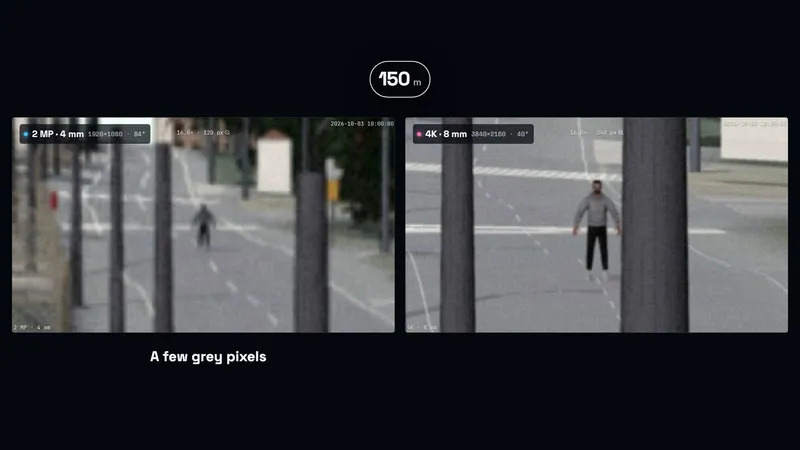
The short answer
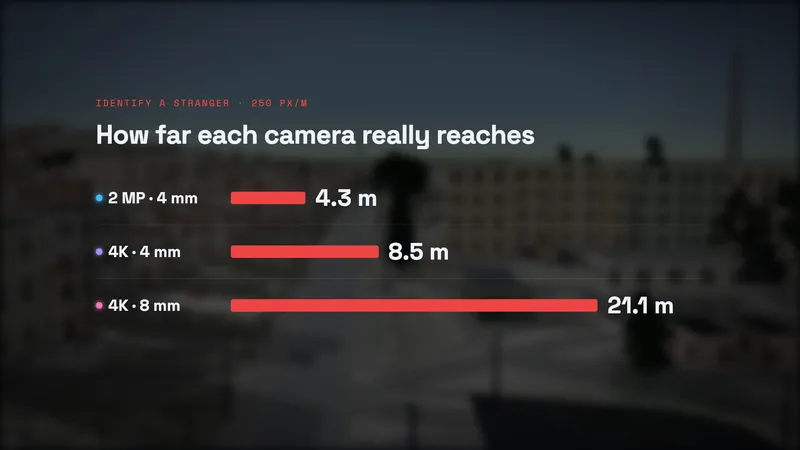
- To identify a stranger (250 px/m): 4.3 m with a 2 MP camera, 8.5 m with a 4K, 21.1 m with the same 4K on an 8 mm lens.
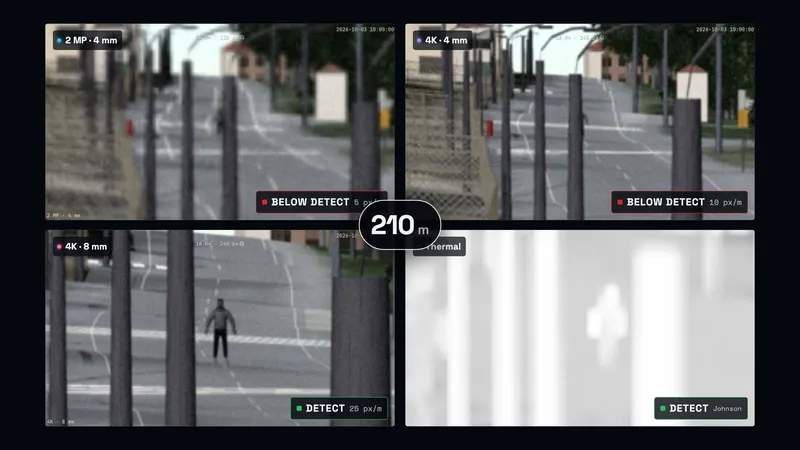
- To detect that someone is there (25 px/m): 42.6 m, 85.3 m and 211 m.
- At night the infrared illuminator decides: about 40 m for these cameras.
- A thermal camera detects a person at 540 m by its datasheet, but never tells you who it is.
The film (3:13) plays from YouTube, in English with English subtitles.
Range is not one number
How far a camera sees depends on how many pixels land on each metre of a person. The European standard EN 62676-4 sets four levels: 25 pixels per metre to detect someone, 62.5 to observe, 125 to recognise someone you know and 250 to identify a stranger.
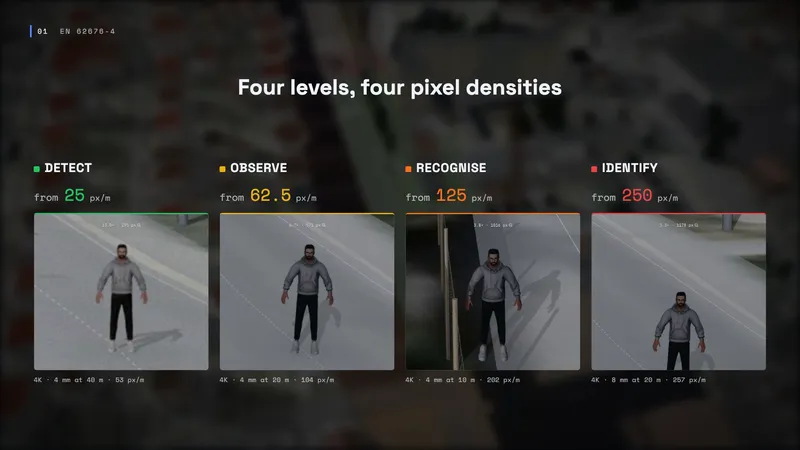
So every camera has four ranges, not one. The table gives them for the three cameras in the test, calculated by the planner from each camera's sensor and lens.
| Camera | Identify | Recognise | Observe | Detect |
|---|---|---|---|---|
| 2 MP · 4 mm · 84° | 4.3 m | 8.5 m | 17.1 m | 42.6 m |
| 4K · 4 mm · 84° | 8.5 m | 17.1 m | 34.1 m | 85.3 m |
| 4K · 8 mm · 40° | 21.1 m | 42.2 m | 84.4 m | 211 m |
The thermal camera, an AXIS Q1952-E with a 10 mm lens and a 640 × 480 sensor, is rated in its datasheet by the Johnson criteria: detection at 540 m, recognition at 135 m, identification at 70 m. For thermal, identification means telling a person from an animal, not knowing who the person is.
The test: one pole, four cameras, one street
We built the test in CCTVplanner on a real street in Bolesławiec, Poland. The ground is the national orthophoto at 5 cm per pixel and the hills come from a 1 m terrain model. The planner imported 1,304 buildings, 310 trees, 200 fences, hedges and walls, the street lamps and a power line from OpenStreetMap.
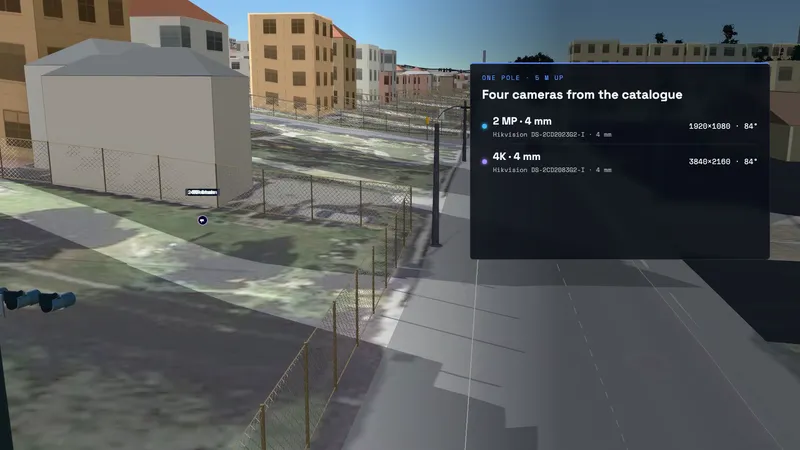
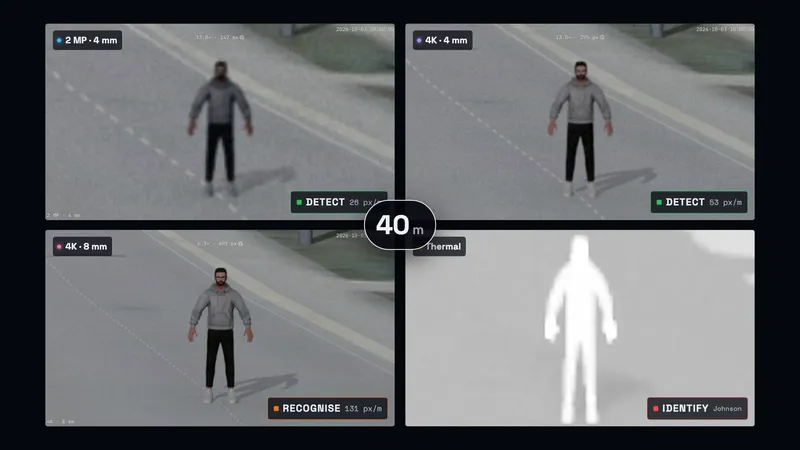
At the end of the street, on one pole 5 m up, stand four cameras from the catalogue: a 2 MP Hikvision DS-2CD2023G2-I and a 4K Hikvision DS-2CD2083G2-I, both with a 4 mm lens, the same 4K with an 8 mm lens, and an AXIS Q1952-E thermal camera. A person walked away from the pole and the planner showed each camera's picture at every mark.
Walking down the street
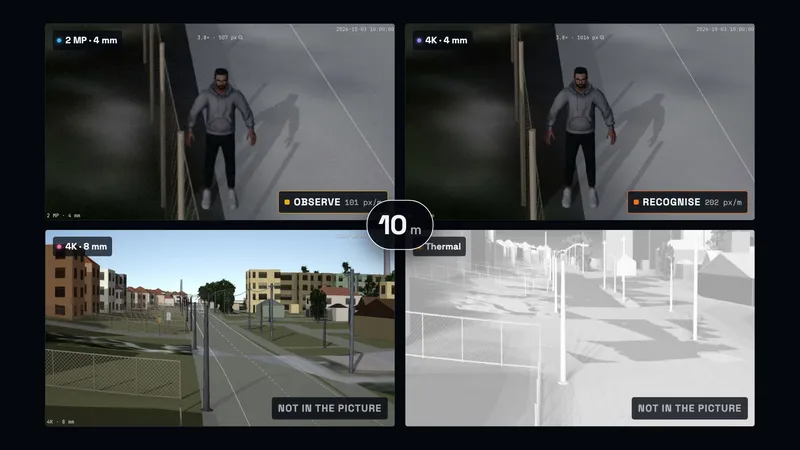
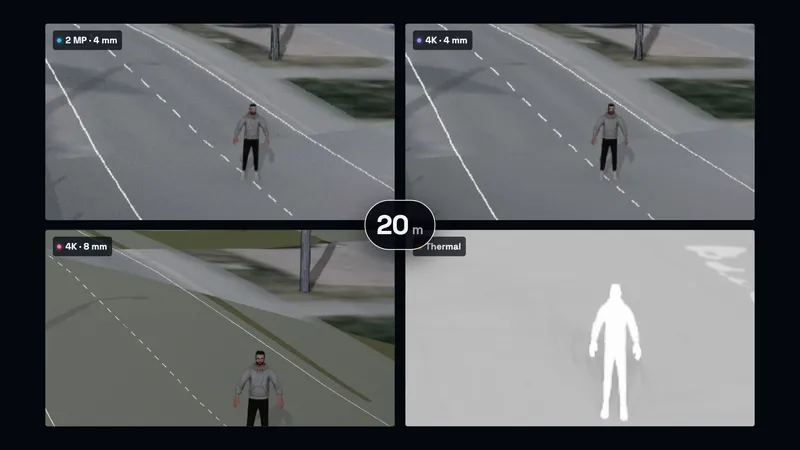
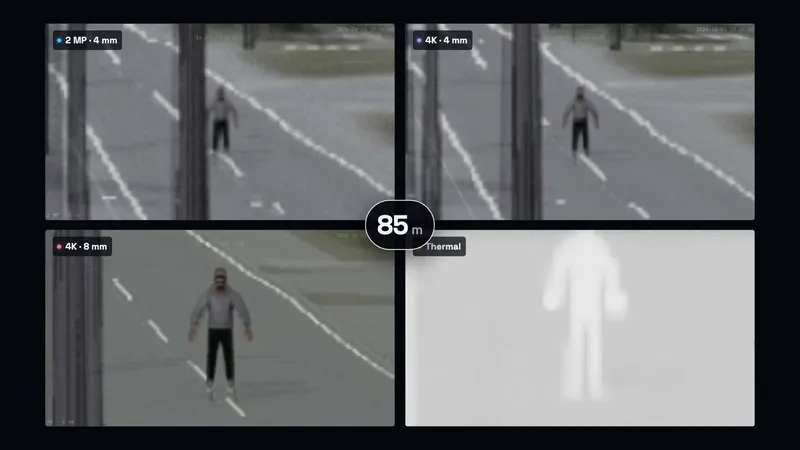
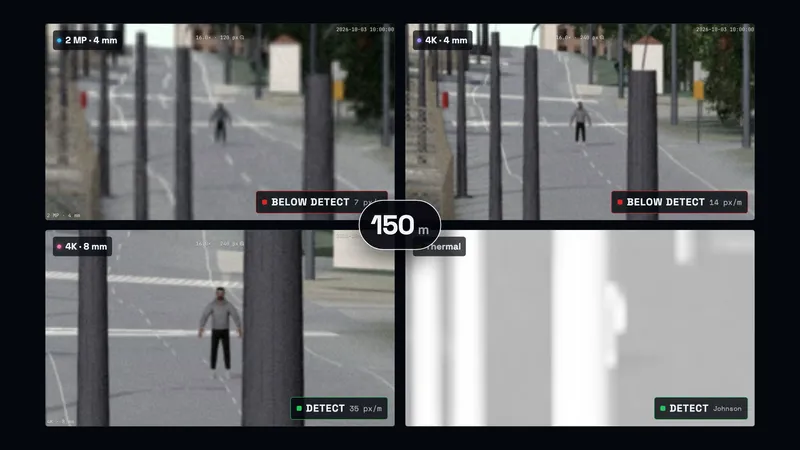
Each picture shows the same moment from all four cameras: 2 MP top left, 4K top right, 4K with the 8 mm lens bottom left, thermal bottom right. The label in each picture is the level the planner measured on the person.
The first mark shows something a datasheet never mentions: at 5 m nobody is in the picture. A camera mounted 5 m up cannot see the ground at its own feet.
A longer lens buys range with width
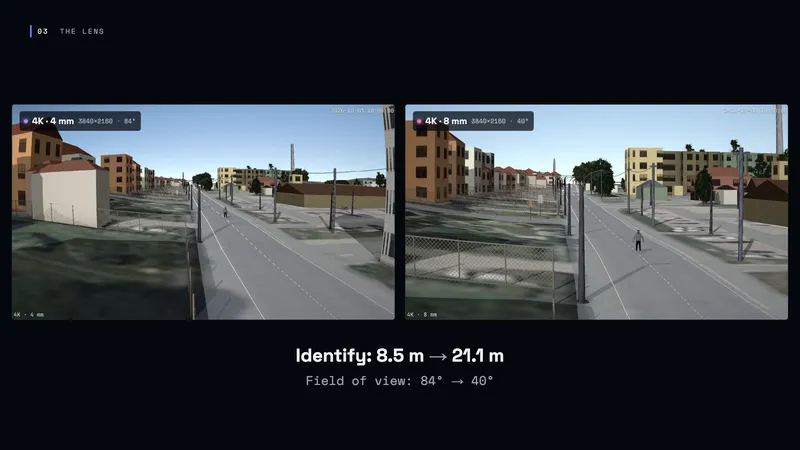
The 8 mm lens sees every distance 2.5 times further than the 4 mm lens on the same 4K camera: it identifies at 21.1 m instead of 8.5 m. But its view narrows from 84° to 40°, so covering the same width takes more cameras.
At night
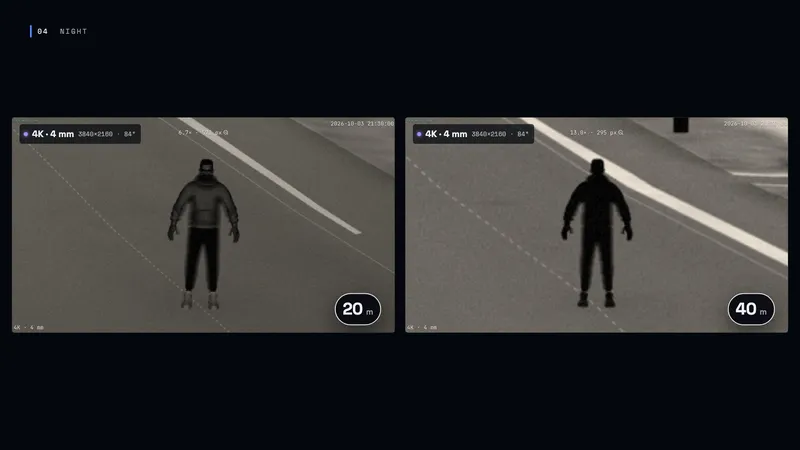
In the dark, the infrared illuminator decides how far the camera sees. These cameras light about 40 m.
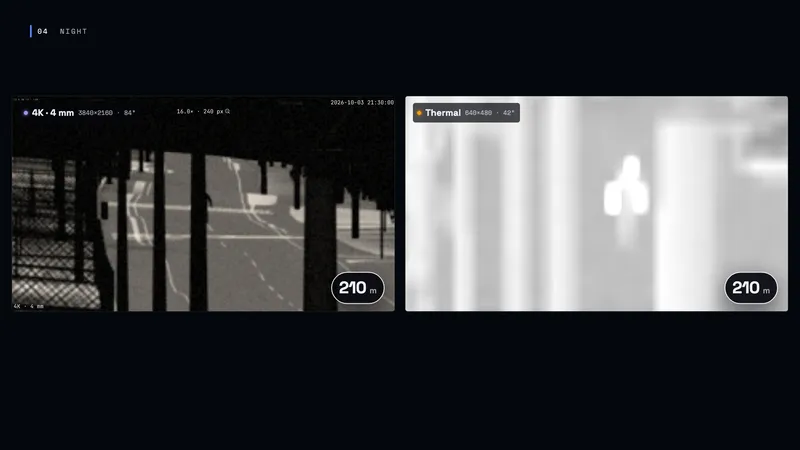
A thermal camera needs no light at all. By its datasheet, the one in the test detects a person at 540 m, day or night. It will never tell you who it is.
What the number on the box means
To identify a stranger, the 2 MP camera needs the person within 4.3 m, the 4K within 8.5 m and the 8 mm lens within 21.1 m.
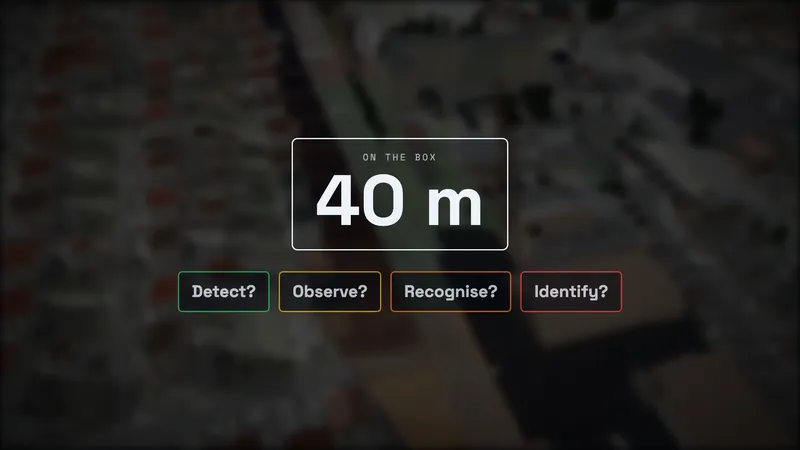
A box that says 40 m usually gives the reach of the infrared illuminator. It does not say whether you can identify anyone at that distance. Always ask: 40 m of what? Detect, observe, recognise or identify.
Check your own camera before you mount it
CCTVplanner calculates these four ranges for every camera you place, from the sensor and lens of the model in the catalogue, and draws them on the map. In 3D you can drop a test person anywhere on the site, read the level the camera reaches on them, and preview what the camera will see.
See what your camera will see
Place a camera from the catalogue on your site and read its identify, recognise, observe and detect ranges.
Questions
How far can a 4K security camera see?
With a 4 mm lens, a 4K camera identifies a stranger to 8.5 m, recognises to 17.1 m, observes to 34.1 m and detects a person to 85.3 m. With an 8 mm lens the same camera reaches 21.1, 42.2, 84.4 and 211 m, with a 40° view instead of 84°.
How far can a 1080p (2 MP) security camera see?
With a 4 mm lens, a 2 MP camera identifies a stranger to 4.3 m, recognises to 8.5 m, observes to 17.1 m and detects a person to 42.6 m.
How far can a security camera see at night?
As far as its infrared illuminator lights, about 40 m for the cameras in this test. Street lighting adds to it, and a thermal camera needs no light at all.
How far can a thermal camera see a person?
The thermal camera in the test, an AXIS Q1952-E with a 10 mm lens, detects a person at 540 m, recognises at 135 m and identifies the kind of object at 70 m, by its datasheet. It does not show who the person is.