
LPR · ANPR · License plate reader

    LPR camera planning: see whether it reads the plate before you install it

    Put a license plate camera on the plan, give the car its speed and open the camera's preview. CCTVplanner simulates the plate under the camera's own infrared, the smear of its shutter and the glare, and tells you whether the plate can be read, and if not, what stops it.

    How ANPR cameras work
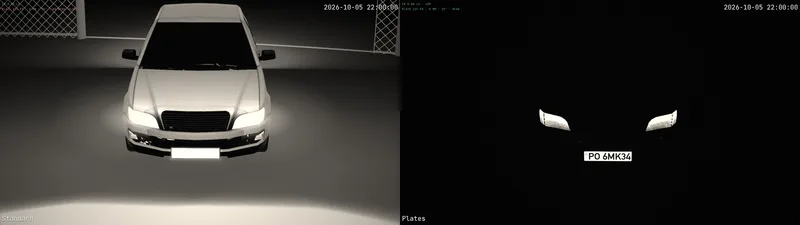
    Two camera previews of the same car at night with its headlights on: an ordinary camera shows the plate as a white patch, a plate camera shows the headlights and a readable plate on black.
    Simulated in CCTVplanner: an Axis P1465-LE (left) and its plate-reading version, the P1465-LE-3 License Plate Verifier (right), on one 3 m pole, 6 m from the car, at 22:00.

    Four checks

    What the preview tells you about a plate camera

    NO.01

    Does it read at night?

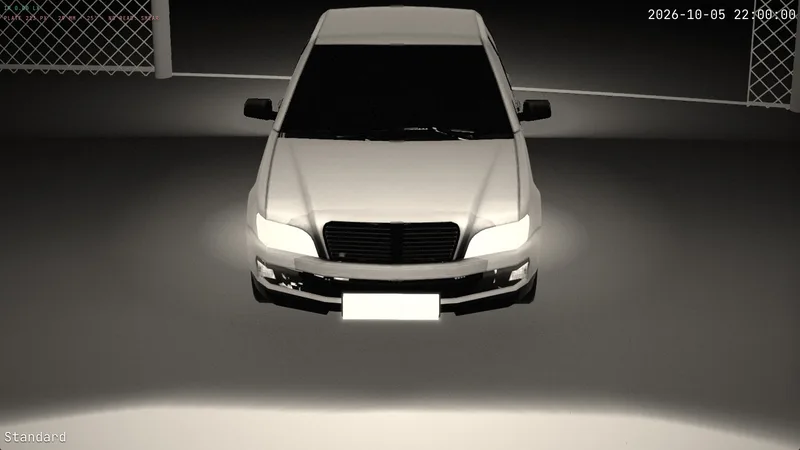
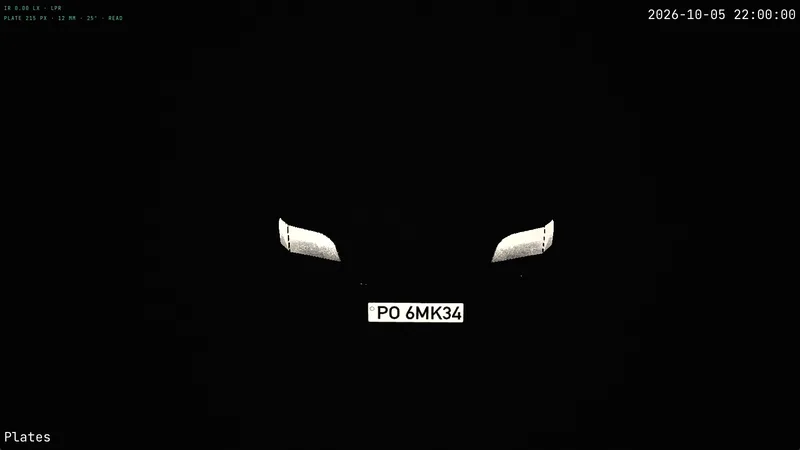
    A number plate is retroreflective: under the camera's own infrared it returns hundreds of times more light than the road. An ordinary camera exposed for the scene burns it into a white patch; a plate camera exposes for the sheeting and reads it on a black frame. The preview works out how far past full scale the plate lands for the camera you placed, at its distance and angle, and draws that.
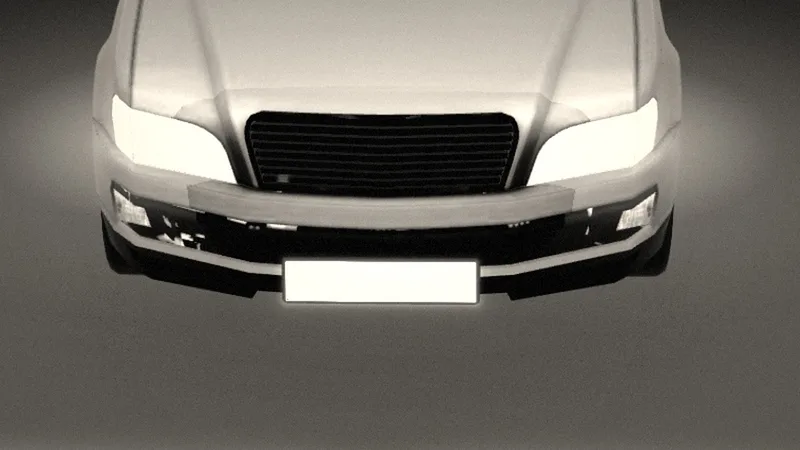
    Close-up of the plate in an ordinary camera's preview at night: a glowing white patch, no characters.
    Ordinary camera: 213 px across the plate, and the verdict NO READ: GLARE.
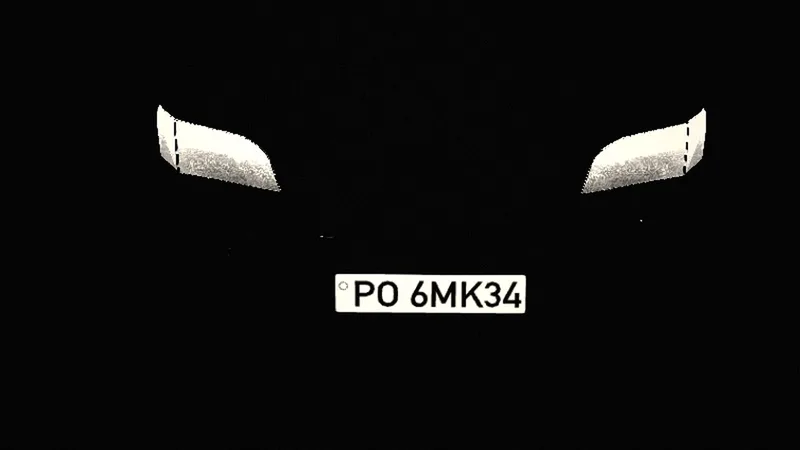
    Close-up of the same plate in a plate camera's preview: the registration PO 6MK34 sharp on black, the headlights blown out beside it.
    Plate camera: 215 px and READ. The headlights stay blown out, as on a real plate camera's frame.
    NO.02

    Does it read a moving car?

    Give the car a speed and the preview smears it by the shutter the camera chose. Axis's rule is that the plate may move no more than about 14 mm across the picture while the shutter is open. At 100 km/h the ordinary camera smears it by 29 mm; the plate camera, at 1/1000 s, by 12 mm.

    Ordinary camera preview of a car at 100 km/h at night, with the verdict NO READ: SMEAR on screen.
    Ordinary camera at 100 km/h: 29 mm of smear, NO READ: SMEAR.
    Plate camera preview of the same car at 100 km/h: a readable plate on black.
    Plate camera at 100 km/h: 12 mm, READ.
    NO.03

    Enough pixels on a real street?

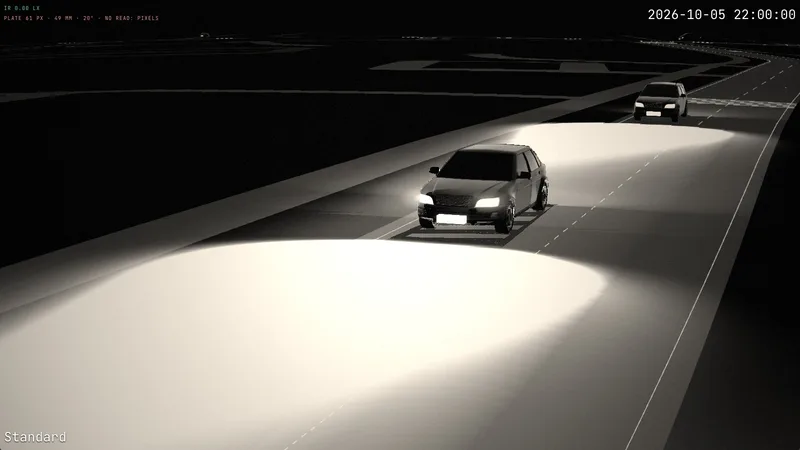
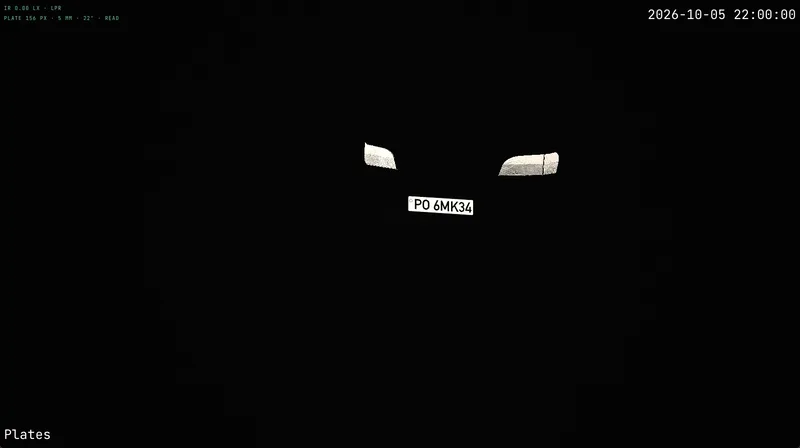
    Both cameras on a 4 m pole over the kerb, aimed 18 m up the street at the oncoming lane, with the 3D roads on so the preview fills them with traffic driving on dipped beams. Every passing car is lit, shaded and smeared in every frame and the verdict follows the best plate in view. Axis puts the floor at 75 pixels across the plate and most reading software asks for 100 to 150, so the ordinary camera's wide view fails on pixels before anything else, and the plate camera's narrow one does not.

    Night preview of an ordinary camera on a pole over a street: oncoming cars with their dipped beams lighting the road ahead of them.
    Ordinary camera, 40° view: the best plate in view is 61 px across, NO READ: PIXELS.
    Night preview of the plate camera on the same pole: an oncoming car's plate readable on black, its headlights blown out.
    Plate camera, 16° view: 156 px, 5 mm of smear, READ.
    NO.04

    And by day?

    In daylight the sun lights the plate and the road alike, so nothing is overexposed: both cameras read the plate, and the plate camera simply gives a monochrome picture. The simulation changes only what physics changes.

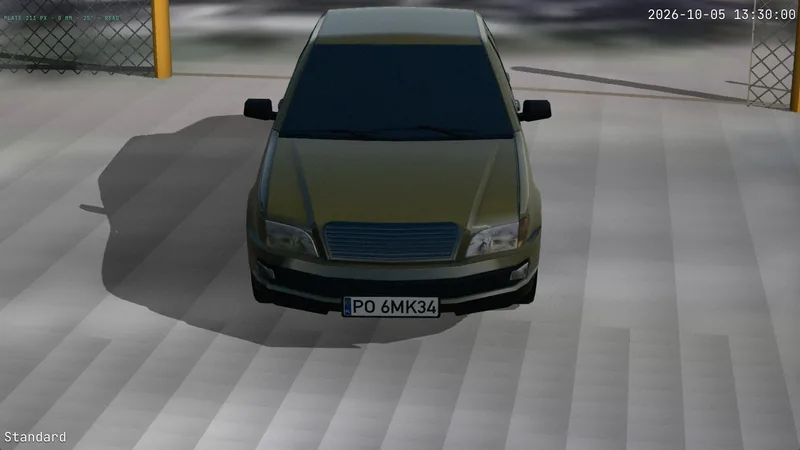
    Ordinary camera preview by day: a car with a readable plate.
    Ordinary camera at 13:30: READ.
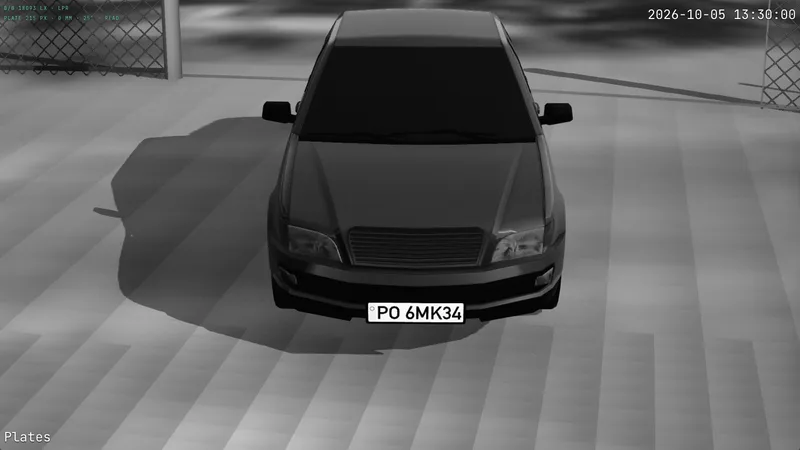
    Plate camera preview by day: the same car in monochrome, the plate readable.
    Plate camera at 13:30: monochrome, READ.

    What it is built on

    Sourced numbers, not a filter

    • Plate sheeting: 3M PB Series 6750, a coefficient of retroreflection of 150 cd/lx/m² straight on, falling to 26 at 30°.
    • Shutter: the plate may smear no more than about 14 mm across the picture (Axis, License plate capture white paper).
    • Pixels: at least 75 across the plate for full contrast, 100 to 150 for most reading software (Axis).
    • Angle: keep the total angle between camera and plate under 30° (Axis).
    • Where each plate is comes from the vehicle models themselves, so the glare lands on the sheeting the picture shows.

    The 3D view and the camera preview are in the Pro plan. See the plans

    Questions

    Why does my camera show the number plate as a white blur at night?

    Because the plate is retroreflective and sends the camera's own infrared straight back, hundreds of times brighter than the road. A camera exposed for the dark scene clips it, and the light the lens scatters covers the characters. A plate camera exposes for the plate instead.

    Which camera do I need to read plates at night?

    One made for it: a short shutter, its own infrared and an exposure set for the plate. In CCTVplanner, filter the catalogue for plate-reading cameras and check the plate in the preview at your site's distance and speed.

    What shutter speed does an LPR camera need?

    Short enough that the plate moves no more than about 14 mm across the picture during the exposure: at 50 km/h and 20° to the lane that is about 1/340 s, and shorter for faster traffic or a wider angle.

    How far can an LPR camera read a plate?

    As far as its lens keeps 100 to 150 pixels across the plate and, at night, its infrared reaches. The preview counts the pixels for the camera and lens you placed.

    Check the plate before you buy the camera

    Place the camera, set the car's speed and read the verdict in the preview, by day and at night.

    License plate camera distance and focal length guide →