

Technical · Thermal imaging · 2026-10-04
Can thermal cameras see through walls?
No. But they see through darkness and smoke, a little further than the eye through fog, and a long way through light rain. Here is what a thermal security camera sees, with pictures from CCTVplanner's thermal preview.

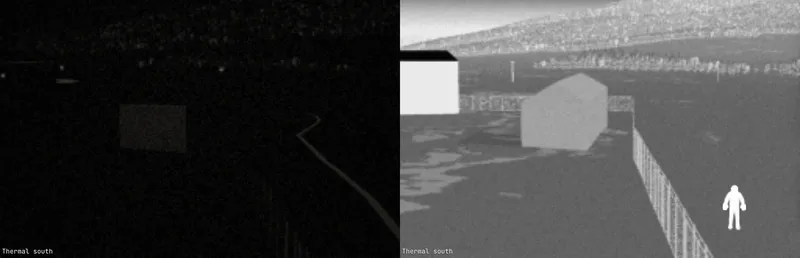
The short answer
- Walls: no. A thermal camera sees the temperature of the wall's surface, not what is behind it.
- Window glass: no. Ordinary glass blocks the 8 to 14 µm band the camera works in, so it sees the glass and reflections on it.
- Smoke: yes. Smoke that hides a fire from the eye is nearly transparent to a thermal camera.
- Fog: a little. In dense fog with 150 m visibility the thermal channel sees about 210 m; in light fog with 1 km visibility, about 1.8 km.
- Darkness and light rain: yes. A thermal camera needs no light, and rain of 2.5 mm/h costs it about 2 dB per kilometre.
Walls: the camera sees the surface
A thermal camera measures the heat a surface gives off, in the 8 to 14 µm band. A wall is opaque in that band, so the camera sees the wall's own temperature. A person standing behind it does not show at all.
What can show is heat that reaches the surface: a hot pipe or a heater behind a thin wall slowly warms the plaster in front of it, and the picture shows that warm patch. It is the wall that is warm, not a view through it.
Window glass is a wall too
Ordinary window glass passes visible light but blocks the long-wave infrared. To a thermal camera behind a window, the pane is a surface with its own temperature that also reflects heat, sometimes the camera's own. Nothing outside shows.
That is why thermal cameras sit outdoors behind a germanium window, a material that does pass the 8 to 14 µm band, and why a thermal camera cannot be tested through an office window.
Thermal camera vs night vision
A night vision camera lights the scene with its own infrared LEDs, usually 850 nm, and sees the light that bounces back. Its range is the reach of that light: about 40 m for the compact cameras in our street test.
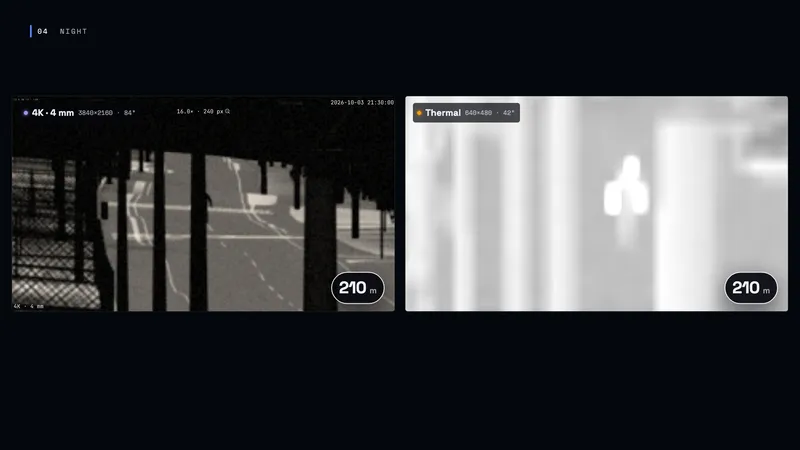
A thermal camera needs no light, because it sees the heat that people, cars and animals give off. In the same test the thermal camera detects a person at 540 m by its datasheet, and at 210 m at night it still shows a person where the 4K camera shows a dark street. What it cannot do is identify anyone: it shows a warm shape, not a face.
Night vision through a window
A night vision camera behind a window fails for another reason: its infrared LEDs light up the glass right in front of the lens, and the reflection floods the picture. If a camera has to look through glass at night, switch its infrared off and rely on the light outside, or mount it outdoors.
Smoke
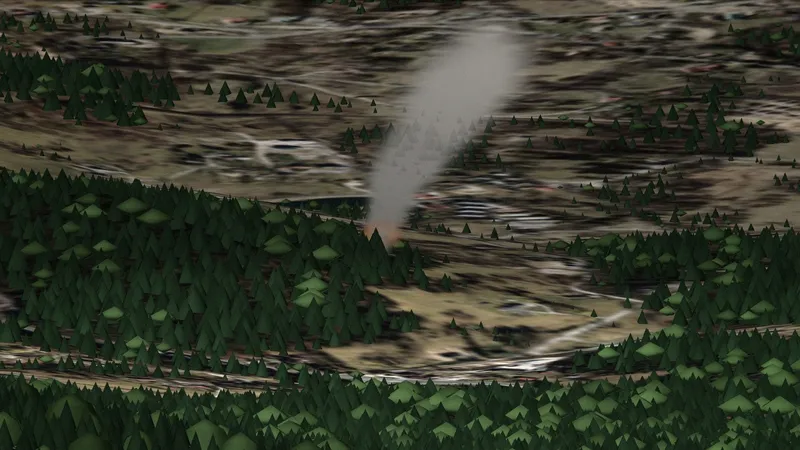
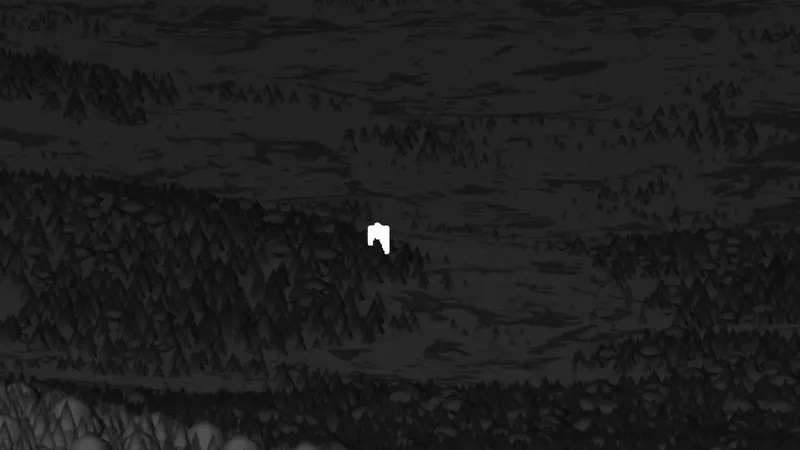
Smoke particles are much smaller than the long-wave wavelength, so they scatter it very little: about 0.2 m² per gram of smoke (Sutherland and Khanna, 1991). In the planner's thermal preview smoke is therefore not drawn at all, and a fire behind its own smoke shows as its flames.
Fog
Fog is different, because its droplets are about the size of the wavelength. The planner ties the water in fog to visibility (Kunkel, 1984) and long-wave extinction to that water (Chýlek, 1978). The result: thermal sees further than the eye, but only 1.2 to 1.8 times further.
| Visibility (eye) | Thermal sees to |
|---|---|
| 50 m | 61 m |
| 150 m | 214 m |
| 500 m | 841 m |
| 1,000 m | 1,849 m |
Both columns are the distance at which 5% of the contrast is left, the definition meteorologists use for visibility.
Rain
Rain costs a thermal camera far less than fog. In the planner's model, light rain of 2.5 mm/h costs about 2 dB per kilometre, heavy rain of 10 mm/h about 5 dB and a downpour of 25 mm/h about 9 dB (Carbonneau).
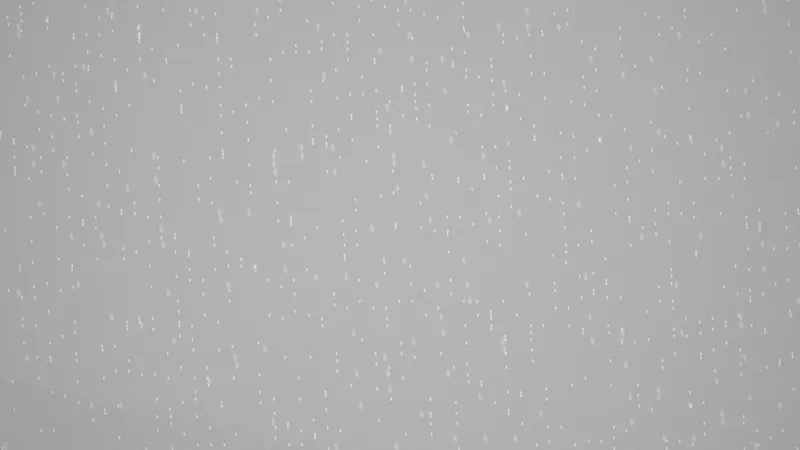
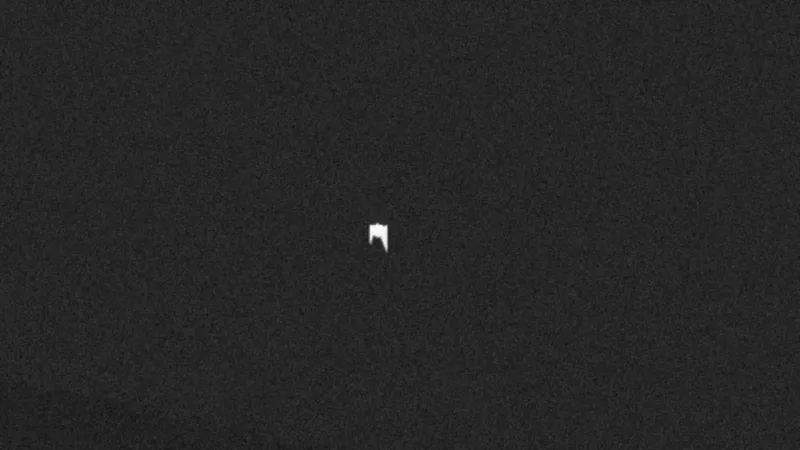
In our forest fire film, light rain cut visibility to 5.9 km and the visible channel showed grey, while the thermal channel still showed the fire 13.2 km away.
What the colours mean
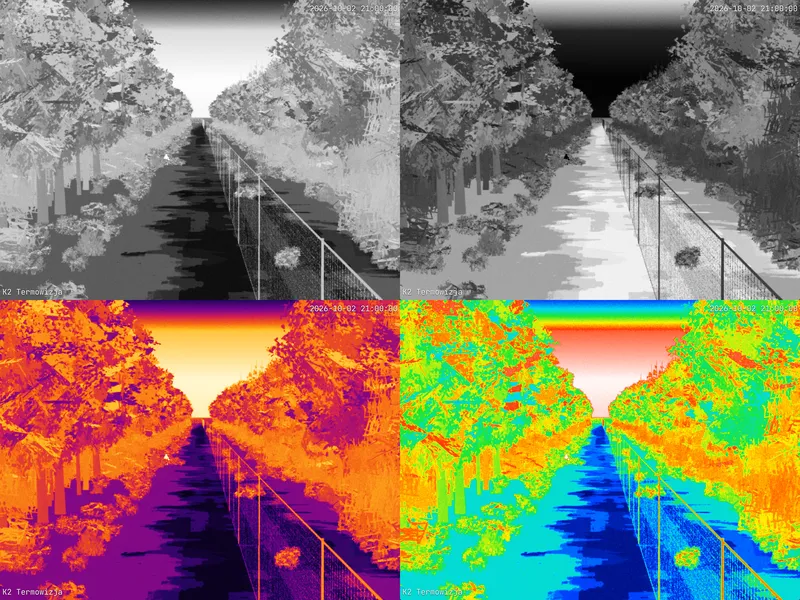
A thermal picture has no colour of its own; the palette maps temperature to shades. White-hot shows warm as white, black-hot as black, and iron-red and rainbow spread the same temperatures over colours. The information is the same in all four, so pick the one your operators read fastest.
Preview a thermal camera before you buy it
In CCTVplanner, a thermal camera from the catalogue shows its thermal picture in the 3D preview, with the time of day, the weather, fog and rain, and the palette you choose. You see what the camera will see before it is mounted.
See what your thermal camera will see
The 3D view and the thermal preview are in the Pro plan.
Questions
Can thermal cameras see through walls?
No. A thermal camera sees the temperature of the wall's surface. A person behind the wall does not show; heat from a pipe or a heater can warm the surface and show as a warm patch.
Can a thermal camera see through a window?
No. Ordinary glass blocks the 8 to 14 µm band, so the camera sees the glass and reflections on it. Thermal cameras look out through germanium windows, which pass that band.
What is the difference between a thermal camera and night vision?
Night vision lights the scene with infrared LEDs and sees the reflected light, typically to about 40 m. A thermal camera sees heat and needs no light; it detects people hundreds of metres away but does not identify them.
Can thermal cameras see through fog and smoke?
Through smoke, yes: it is nearly transparent in the long-wave infrared. Through fog only a little better than the eye: in the planner's model 1.2 to 1.8 times further, depending on how dense the fog is.
Four cameras on one pole, one person walking down a real street: identify, recognise, observe and detect distances for 2 MP, 4K and thermal.
Complete guide to night vision CCTV systems. Compare infrared, thermal imaging, and low-light options. Learn what works best for your needs.